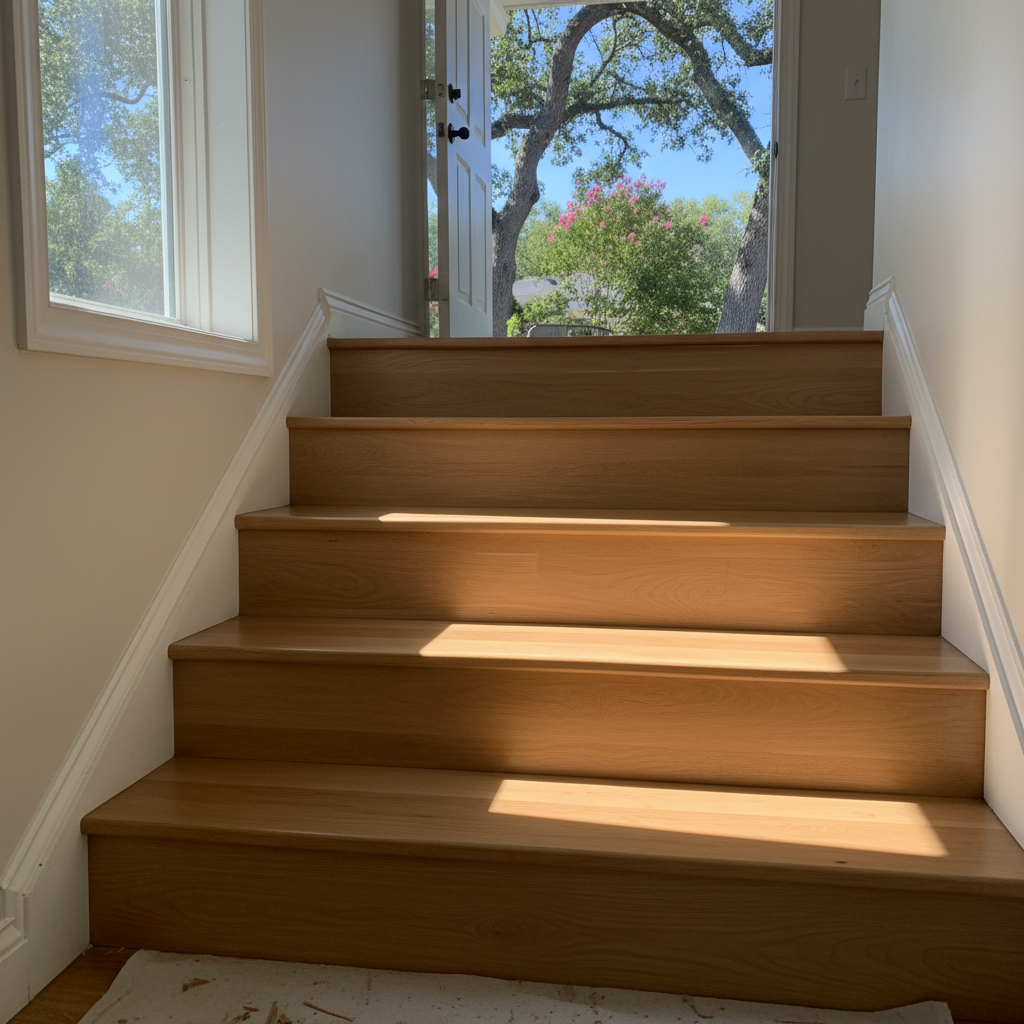
Alright, let's talk about stairs. You might be thinking about new flooring for your whole house, and then you get to the stairs and realize, "Wait, this is different." You're right, it is. Stair flooring isn't just a straight shot of planks or carpet; it's a whole different beast when it comes to installation and, yep, cost. Here in San Antonio, I see folks all the time surprised by the price tag for their stairs. So, let's clear up some of the mystery around what you'll actually pay.
What Makes Stair Flooring More Expensive?
It's not rocket science, but it's definitely more labor-intensive than a flat floor. Think about it:
- Precision Cuts: Every single tread (the part you step on), riser (the vertical part), and often the stringer (the side piece) needs to be cut precisely to fit. You can't just roll out a carpet or snap together a laminate plank.
- More Material Waste: Because of all those cuts, you're going to have more waste material than you would on a flat floor. Good installers factor this in.
- Specialized Tools & Skills: It takes a different set of tools and a lot more skill to make stair flooring look good and, more importantly, be safe. You don't want gaps or uneven edges on stairs.
- Safety First: Installers are working on steps, often in tight spaces. It's slower, more careful work to ensure a quality, safe finish.
Typical Cost Ranges for Stair Flooring in San Antonio
Okay, let's get down to brass tacks. These are general ranges for a standard 12-14 step staircase, including labor and materials. Keep in mind, these are averages, and your specific situation might vary.
- Carpet: This is usually your most budget-friendly option. For a decent quality, durable carpet suitable for stairs, you're looking at anywhere from $35 to $70 per step. That includes padding, installation, and the carpet itself. So, for a 13-step staircase, you might be in the $450 - $900 range. If you want something really plush or a custom runner, that can go higher.
- Laminate: Laminate can be tricky on stairs, but it's doable. You'll need special stair nose pieces for each tread, which adds to the material cost and installation complexity. Expect to pay around $60 to $120 per step. For our 13 steps, that's roughly $780 - $1,560. Make sure your installer has experience with laminate on stairs; it's not for beginners.
- Engineered Hardwood: This is a popular choice and looks fantastic. You'll use full planks for the treads and risers, often with matching stair nosings. For engineered hardwood, you're usually looking at $80 to $180 per step. That puts a 13-step staircase in the $1,040 - $2,340 range. Quality of wood, finish, and brand will play a big role here.
- Solid Hardwood (New Treads & Risers): If you're replacing existing treads and risers with solid hardwood, this is typically your most premium option. It's a significant upgrade. You're talking about $150 to $300+ per step. So, for 13 steps, that's anywhere from $1,950 to $3,900 or more. This often involves custom milling and finishing on-site, which takes time and expertise.
- Refinishing Existing Hardwood Stairs: If you've already got solid wood stairs that are just looking tired, refinishing is a great option and usually less expensive than a full replacement. This involves sanding, staining, and sealing. Expect to pay around $60 to $120 per step, so $780 - $1,560 for 13 steps. This is a messy job, but the results can be stunning.
Remember, these numbers are for standard, straight stairs. If you have a curved staircase, a landing, or a complex design, expect those costs to climb even higher due to increased labor and material needs.
What Should a Good Quote Include?
When you get a quote from a reputable company like San Antonio Hardwood Floor Solutions, it should be clear and comprehensive. Here's what you want to see:
- Material Costs: Itemized for treads, risers, nosings, carpet, padding, etc.
- Labor Costs: This should cover the installation of all materials.
- Demolition & Disposal: If your old flooring needs to be removed and hauled away, this should be included. Don't assume it is.
- Prep Work: Sometimes subfloor repairs or leveling are needed, especially if you're switching from carpet to hard surface.
- Finishing Touches: Things like quarter round or shoe molding along the baseboards if applicable.
- Sales Tax: Don't forget this!
- Warranty Information: Both on materials and the installation itself.
A good quote won't just be a single number. It'll break things down so you understand exactly what you're paying for.
How to Avoid Overpaying for Stair Flooring
Nobody wants to get ripped off, especially not on something as visible and important as your stairs. Here's my advice:
- Get Multiple Quotes: This is probably the most important thing you can do. Get at least three detailed quotes from different local San Antonio contractors. Don't just go with the cheapest; compare what each quote includes.
- Check References & Reviews: Look up their work. Ask for pictures of stair projects they've done. Read online reviews. You want someone with a proven track record specifically with stairs.
- Be Specific About Materials: Know what you want. If you just say